


MATERIALS IN USE

KULINI
Post-consumer coffee byproduct
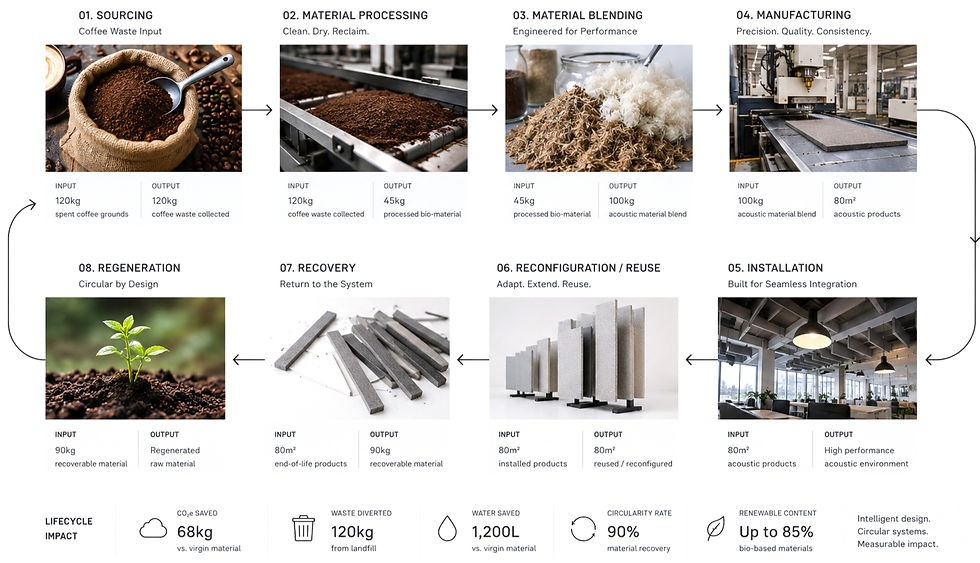
Kulini is a high-performance commercial interior solution manufactured directly from recycled post-consumer coffee byproduct streams to deliver targeted wave-attenuation profiles across high-occupancy corporate layouts. Moving far beyond unmanaged organic waste use, the system stabilises raw biogenic byproduct mass via mechanical moisture-calibration and precision compounding with mineral binders and plant-derived, non-toxic bio-resins to eliminate toxic synthetic chemical glues.The processed compound is formed into structurally stable acoustic panels through an automated high-pressure compression-moulding system, producing a dense, rigid composite matrix characterised by an irregular micro-porous surface topology and a tortuous internal cell network. This engineering-first architecture functions as high velocity boundary asset targeting mid-to-high frequency sound wave attenuation (500Hz - 2000Hz) at 20mm through to an active sub-surface pressure trap, maximising viscous flow resistance to target, damp, and encapsulate lower-mid frequency sound waves (250Hz - 500Hz) at 40mm where heavy vocal fundamentals and mechanical HVAC rumbles pool.

BOTORU
Technical Polymer Substrate
Botoru Felt is a dense, non-woven technical polymer substrate engineered for high-capacity sound wave attenuation and structural face resilience across extensive ceiling and wall installations. Manufactured by converting post-consumer polyethylene terephthalate (PET) mass streams into highly porous, interconnected fibre matrices, Botoru Felt functions as a viscous friction barrier for incident sound waves, repurposing 52 to 80 plastic bottles per square meter depending on structural thickness parameters (12mm to 24mm profiles). The underlying mechanical recycling process reduces operational energy demands by up to 70% and water volume extraction by up to 60% compared to virgin structural polymer synthesis, delivering a highly durable, impact-resistant face structure that will not pit, dent, or shed respirable particles under high-velocity overhead
POLYCORE
Shredded Post Consumption Recycled Polyester Fabric
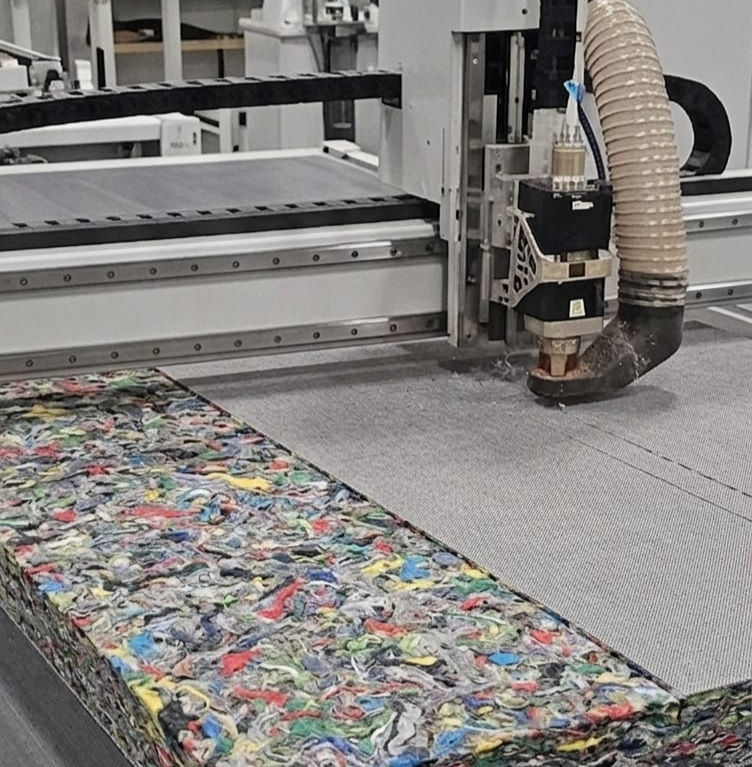
PolyCore Acoustic Infrastructure System is a high-performance commercial interior solution engineered from shredded post-industrial and post-consumer recycled polyester fabric waste to deliver targeted broadband wave attenuation within high-occupancy corporate environments. Moving far beyond unmanaged textile waste accumulation, the system stabilises raw synthetic fibre streams through automated mechanical sorting, fibre opening, and precision heat-press thermal bonding toolpaths that eliminate the need for toxic chemical binders or formaldehyde-heavy resins. The processed polymer mass is consolidated into structurally stable, high-density acoustic cores characterised by an ultra-porous, highly interconnected fibre matrix. This engineering-first architecture functions as a heavy-duty mechanical dampening layer, leveraging high airflow resistance to trap multi-directional sound waves and dissipate incident acoustic energy via intense viscous boundary-layer friction. Engineered as an explicit, high-capacity alternative to hazardous mineral wool or high-mass fiberglass insulation, this stable sub-surface core targets the critical frequencies of human vocal interaction (500Hz - 2000Hz) - transforming a volatile global textile waste stream into a lightweight, durable, and enterprise-ready architectural asset designed for non-destructive de-mounting and 100% downstream material recovery at commercial lease termination.
ECOXAN SUBSTRATE
Upcycled Corrugated Paperboard Grids
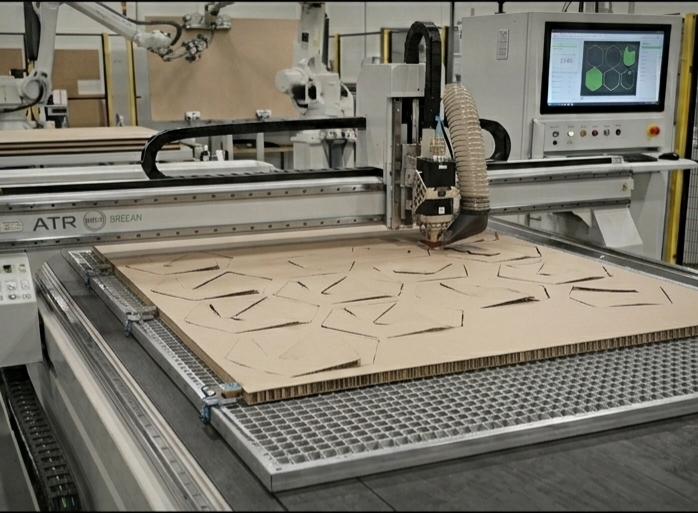
EcoXan is an advanced, high-strength industrial bio-composite infrastructure board manufactured from up to 100% post-consumer cell fibre and upcycled corrugated paperboard grids. Moving away from heavy, high-mass medium-density fibreboards (MDF) or gypsum substrates that fracture under impact and permanent installation, EcoXan utilises a rigid, three-layer structural architecture featuring a ruffled, fluted internal core precision-sandwiched between dense outer containment liners. This configuration shows an exceptional strength-to-weight ratio that reduces long-term sagging, twisting, or bowing across continuous 3-meter spans, while its engineering-first architecture supports adhesive-free friction-fit interlocking connections for rapid facility de-mounting and circular material reclamation at corporate lease termination. currents.
Our material strategy is defined by Industrial Resource Re-Engineering (IRR), a method that intercepts high-volume industrial and post-consumer byproduct streams—such as coffee grounds, polyester fibre, and corrugated paperboard—diverting them from landfill cycles to elevate them into high-performance, structural architectural infrastructure.
For ATR, waste-derived inputs engineered into high-performance acoustic systems where circularity, aesthetic and acoustic function are mutually reinforcing, not compromising features in Circular Architectures.
By utilising precision mechanical stabilisation, fibre-opening, and high-pressure compression-moulding toolpaths, we eliminate the need for toxic synthetic glues or formaldehyde-heavy resins, ensuring structural integrity through mineral and thermal-fusion bonding. This commitment to circularity extends into the built environment via our Full Lifecycle Asset Recovery (FLAR) model, which mandates non-destructive mechanical mounting for easy de-mounting and guarantees 100% downstream material reclamation at lease termination, all while delivering laboratory-certified, drift-free acoustic performance for the duration of the asset’s lifecycle.